
Reads
Tracing a ceiling stain to its source: roof, pipe, appliance or air handler?
A ceiling stain has a source above or inside it, and when the stain grows usually narrows the list. This guide walks from the timing of the drip to the room overhead and the attic hatch, with the safety lines first.
If this, then look there
| If this is true | Look first at | Read next |
|---|---|---|
| The stain grows during or after rain | The roof, flashing, a vent or the attic insulation | Storm damage |
| It grows after showers or baths | The tub, shower pan or drain line overhead | Ceiling leaks |
| It grows after the washer or dishwasher runs | The hose, valve or drain above | Appliance leaks |
| It is there with no weather and no use | A supply line inside the wall or ceiling | Burst pipes |
| It shows near vents or the air handler | The condensate drain or a duct | Ceiling leaks |
| The ceiling droops, or the water is brown and smells | A drain line or sewage; keep clear | Sewage backup |
Safety comes before the detective work
A ceiling that droops, bulges or drips has taken on water and gotten heavy. The Red Cross says striking the middle of the damaged area may bring the whole ceiling down, so no poking, and no standing underneath.
If water runs through a light fixture or a ceiling fan, do not touch the switch; leave the room and use 911 or the electric utility. Nothing in this guide needs a ladder or a tool.
Read the timing
When the stain grows narrows the list. Growth during or after rain points up, at the roof, flashing or attic insulation; in the Atlanta normals the lightest month, October, still gets 3.28 inches and the heaviest, July, gets 4.75, so some rain is never far off. Growth after a shower or bath points to the bathroom overhead. Growth after the washer or dishwasher runs points to a hose or drain above. A stain that grows with no weather and no use points to a supply line in the wall or ceiling.
Walk the room above
UGA Extension's maintenance checklist asks homeowners to check faucets, tubs and showers for leaks, toilets and tanks, washer hoses, and the water heater. The EPA's WaterSense guide says about 20 percent of toilets leak and names failed washing machine hoses and water heaters as common sources of large leaks. Press a dry paper towel along caulk lines, around the toilet base and behind the washer.
Take the attic hatch look
UGA's checklist starts with the roof and attic when it lists places to look for leaks and stains. From the hatch, with the ladder under your feet, run a flashlight beam over the roof boards from below and across the insulation. Photograph dark patches, drips or insulation that looks matted. Stay on the ladder; stepping between joists is the contractor's call.
When the answer stays hidden
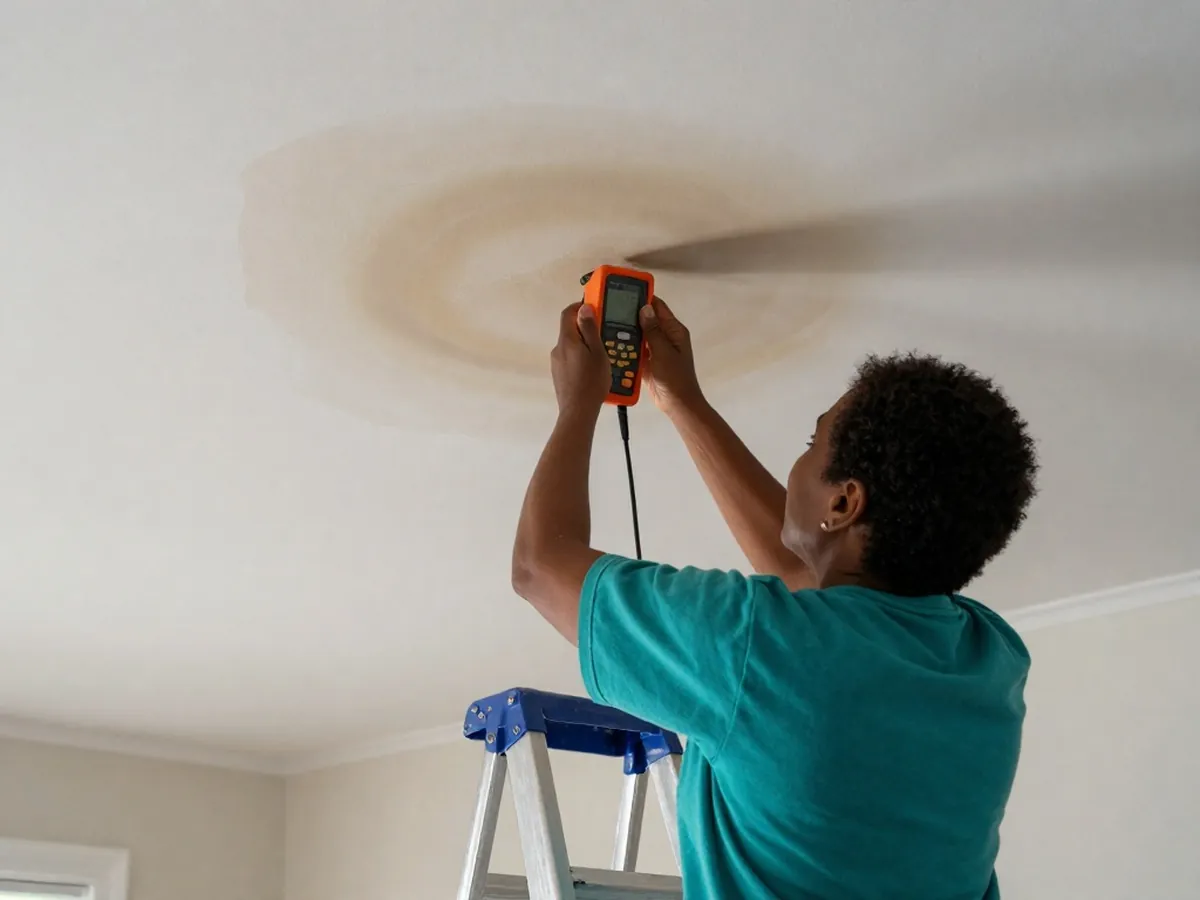
Pipes, ducts and roof leaks all travel along framing, so the stain is rarely directly under the source. A moisture meter and an opened section of drywall settle what a flashlight cannot. The EPA advises repairing the source and drying everything completely, and says mold can grow in drywall left wet more than 24 hours.
Found the source and still have a wet room?
Tracing is the first half; the other half is getting the wet material out and dry. The ceiling leak page and the storm damage page cover what happens next. Call (678) 737-4866 and describe when the stain grows and what sits above it.